Fortuny apartment
The Shadow of the WindThe Fortuny apartment is at once a neglected family home, a repository of scattered evidence about Julián Carax, and the address through which a manipulated official record helps conceal his survival. Daniel Sempere enters it while tracing Carax’s past; there, ordinary domestic objects and locked rooms yield traces of an absent life, while a hidden crypt gives physical form to a history of loss that the public account has obscured.
Setting and condition
The apartment lies in Ronda de San Antonio, in the former home of Carax’s father. When Daniel asks whether anyone lives there, the caretaker explains that the old man died without a will and that his wife had not returned from Buenos Aires even for the funeral. The apartment is therefore not simply vacant: it is a family space left without an active custodian, where death and absence have become part of the surroundings.
Daniel and the caretaker find the entrance swollen with neglect. Dust and grime cover the corridor, and footprints cross the floor, making the decay legible as something recently disturbed rather than wholly untouched. The signs of intrusion lead Daniel to suspect someone has been inside, turning the apartment from a ruined setting into a place where the past may still be actively pursued.
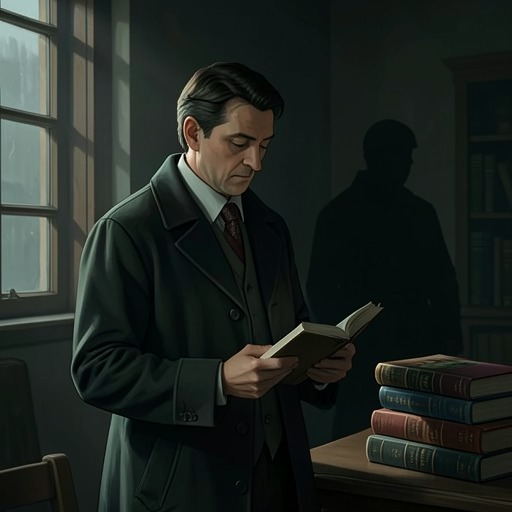
The dining room retains a shabby table, four chairs, glass cabinets, and the upright piano that belonged to Carax’s mother. Nearby, an armchair and a small table hold reading glasses and a pale leather Bible with a scarlet-string bookmark. The caretaker identifies the armchair as the place where Carax’s father was found dead, alone for two days. These objects preserve the outline of daily life, but in the context of the father’s death they also register how completely that household has fallen into isolation.
Rooms as evidence
Among the belongings beside the dead man’s chair is a box of old studio portraits. One photograph shows a young couple with a small boy whom Daniel recognizes as Carax. The apartment’s evidence is personal and fragmentary: family identity comes to Daniel not through a reliable account but through images and objects left behind in rooms no longer maintained.
In another bedroom, Daniel finds an unmade four-poster bed, a crucifix, a basin and pitcher, and photographs, funeral cards, and lottery tickets beneath the glass top of a bedside table. A carved wooden music box and a pocket watch stopped at twenty past five suggest a private world suspended in time; when Daniel tries the music box, its melody catches after six notes. The room adds details to the apartment’s inventory without explaining them, preserving the distinction between what the objects disclose and what remains unknown.
The footprints lead to a locked door. Inside, crucifixes cover the walls and hang from the ceiling; more have been carved, scratched, or painted onto furniture and surfaces. Around a bare, damaged bed, the tracks continue through the dust to a desk whose forced drawers are empty. The untouched joins in its wooden slats indicate to Daniel that it has been opened recently. The room’s accumulated religious imagery and disturbed desk make it seem less like an ordinary bedroom than a space marked by prolonged withdrawal and renewed searching.
The desk nevertheless contains notebooks, pencils, and pens. The notebooks gather drawings, mathematical exercises, isolated phrases, quotations, and unfinished poems. Repeated sketches include a man made of flames, a figure that might be an angel or a reptile coiled around a cross, and a fantastic house with towers and cathedral-like arches. Their unfinished, recurring images make the room a record of Carax’s early creative life, although they do not provide a complete explanation of his later fate.
Penélope’s photograph and letter
A photograph slips from one of the notebooks. It shows the same girl Daniel has seen in another picture, now posing in a luxurious garden; beyond the trees stands the villa called The White Friar, on Avenida del Tibidabo. The inscription on the back reads, “Penelope, who loves you”. Daniel recognizes the villa and keeps the photograph, carrying a private connection out of the apartment and into his investigation.
The photograph’s discovery is followed by another trace of the same relationship. Back at home, Daniel examines an envelope addressed to Carax that he had taken from the caretaker. Its postmark reads 18 October 1919, and its return address names Penélope Aldaya at Avenida del Tibidabo, 32, Barcelona. The old paper and the traces left on its seal place the letter within the same network of material clues as the photograph. The apartment thus connects a domestic archive to evidence from outside the house, linking Carax’s private history to the Aldaya address.
The crypt and the family secret
Later, Daniel returns to the Aldaya mansion with Bea and descends a staircase into a concealed crypt. The room contains two white coffins, one scarcely two feet long. As he clears the dust from the larger lid, he reads the name Penélope Aldaya and the dates 1902–1919. The small coffin establishes that a child lies beside her, though Daniel has not yet learned the child’s identity from this inscription alone.
When Carax later enters the same crypt, the two tombstones identify Penélope Aldaya and David Aldaya; the dates give Penélope’s life as 1902–1919 and David’s death as 1919. The paired graves make explicit the family history that the apartment’s scattered clues could only suggest: Penélope and her son died in the same year and were buried together. The crypt is not inside the apartment, but it completes the apartment’s work as an archive of a concealed past: its photographs and letter point toward Penélope, while the graves show the cost and permanence of the history being uncovered.
Official identity and later transformation
The apartment also figures in the false identification of Carax. In the account of the morgue records, a man brought in during September 1936 carries a book and a passport identifying him as Julián Fortuny Carax, born in Barcelona in 1900. The passport indicates that Carax had crossed back into the country a month earlier, and Carax’s father is summoned to identify the body. The official procedure appears to attach Carax’s name to the remains, but the account is later exposed as part of a deliberate deception.
The fuller explanation is that Miquel Moliner is killed and his body is left in an alley in the Raval quarter. Because he has left his papers at home, the morgue finds only a damaged passport in Carax’s name and a copy of Carax’s novel, The Shadow of the Wind. The police consequently conclude that the dead man is Carax. When Carax’s father is brought to identify the body, his response is misread; Francisco Javier Fumero recognizes Miquel, nevertheless signs the report identifying him as Carax, and orders the body sent to a common grave on Montjuic. The apartment’s address remains on the passport as Carax’s residence, making the abandoned home part of the documentary trail that sustains the false death.
In the later account of the city, the apartment belongs to a past whose evidence survives unevenly: objects and documents preserve clues, while official records are capable of closing over the truth. That contrast gives the home a significance beyond its decay. It is a physical record of Carax’s family life and a point in the chain by which his identity is concealed, while Daniel’s movement through its rooms helps restore connections that the manipulated public record has erased.